Captions have become an essential part of online video content. Whether you’re watching videos on social media, streaming platforms, educational websites, or television, captions help viewers understand spoken content more easily.
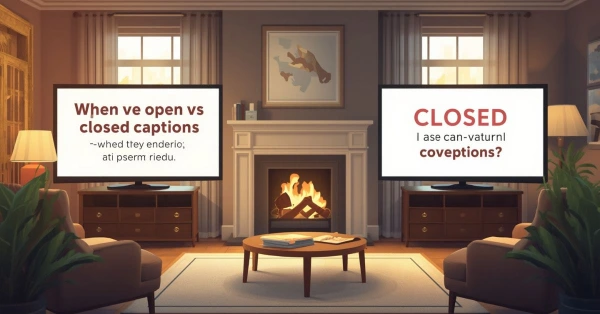
If you’ve ever wondered about the difference between open vs closed captions, you’re not alone. Many people use these terms interchangeably, but they are actually two different types of captions.
Understanding the difference can help content creators, businesses, educators, and viewers choose the best option for their needs. Both open and closed captions improve accessibility, support viewers who are deaf or hard of hearing, and make content easier to understand in noisy environments.
In this guide, we’ll explain what open captions and closed captions are, how they work, their advantages and disadvantages, and when to use each type.
What Are Open Captions?
Open captions are captions that are permanently embedded into a video. They are always visible and cannot be turned off by the viewer.
Unlike other caption types, open captions become part of the video file itself. This means they will appear on every device and platform where the video is played.
Features of Open Captions
- Always visible
- Cannot be disabled
- Embedded directly into the video
- No additional caption file required
- Works on all video players
Example
Many social media videos on platforms such as Instagram, TikTok, and Facebook use open captions because viewers often watch videos without sound.
What Are Closed Captions?
Closed captions are captions that viewers can turn on or off whenever they choose.
Unlike open captions, closed captions are stored separately from the video. They appear only when enabled through a video player’s caption settings.
Closed captions often include more information than standard subtitles. They may identify speakers and describe important sounds such as music, laughter, or background noises.
Features of Closed Captions
- Optional for viewers
- Can be turned on or off
- Stored separately from the video
- Support multiple languages
- Include sound descriptions
Example
Streaming platforms like YouTube and Netflix commonly use closed captions, allowing viewers to customize their viewing experience.
Open vs Closed Captions: Main Differences
The biggest difference is viewer control.
Open captions are permanently displayed, while closed captions can be enabled or disabled.
| Feature | Open Captions | Closed Captions |
|---|---|---|
| Turn On/Off | No | Yes |
| Embedded in Video | Yes | No |
| Always Visible | Yes | No |
| User Control | No | Yes |
| Multiple Languages | Limited | Yes |
| Requires Caption Support | No | Yes |
Benefits of Open Captions
Open captions offer several advantages for content creators and viewers.
1. Universal Compatibility
Since open captions are embedded into the video, they work on all devices and platforms.
2. Better Social Media Engagement
Many users scroll through social media with sound turned off. Open captions help viewers understand content immediately.
3. No Technical Issues
There is no need to worry about caption files not loading correctly.
4. Increased Accessibility
Everyone watching the video can see the captions automatically.
Drawbacks of Open Captions
Despite their benefits, open captions have some limitations.
No Viewer Control
Viewers cannot remove captions if they find them distracting.
Limited Language Options
Adding multiple language versions requires creating separate videos.
Design Limitations
Once captions are embedded, they cannot be edited easily.
Benefits of Closed Captions
Closed captions provide flexibility and customization.
1. User Choice
Viewers can decide whether they want captions.
2. Multiple Languages
Platforms can offer several caption languages within the same video.
3. Better Accessibility
Closed captions often include sound effects and speaker identification.
4. Customizable Appearance
Many video platforms allow users to adjust caption size, font, and color.
Drawbacks of Closed Captions
Closed captions also have a few disadvantages.
Platform Dependency
The video player must support caption files.
Technical Problems
Captions may fail to load or sync properly.
Additional Setup
Creators need to upload and manage caption files separately.
When Should You Use Open Captions?
Open captions work best in situations where accessibility and visibility are priorities.
Best Uses for Open Captions
- Instagram Reels
- TikTok videos
- Facebook videos
- Digital advertising
- Public displays
- Social media marketing
These platforms often have users watching without sound, making open captions highly effective.
When Should You Use Closed Captions?
Closed captions are ideal for longer-form content where viewers may want more control.
Best Uses for Closed Captions
- YouTube videos
- Online courses
- Streaming services
- Corporate training
- Educational content
- Webinars
Closed captions allow viewers to customize their experience and choose different languages.
Why Captions Matter
Captions are valuable for more than accessibility.
Improved User Experience
Many viewers prefer captions even when they can hear the audio.
Better Engagement
Videos with captions often receive higher watch times and engagement rates.
Enhanced Accessibility
Captions help people who are deaf or hard of hearing enjoy video content.
Better SEO
Search engines can index caption text, helping videos appear in search results.
Open Captions vs Subtitles
Many people confuse captions and subtitles.
Captions
Captions include spoken dialogue and important sounds.
Example:
[Door closes]
Sarah: I’ll see you tomorrow.
Subtitles
Subtitles only display spoken dialogue and are typically used for translation.
Example:
I’ll see you tomorrow.
Captions focus on accessibility, while subtitles focus on language translation.
Frequently Asked Questions
Are open captions better than closed captions?
Neither is universally better. Open captions are great for social media, while closed captions offer more flexibility and accessibility options.
Can viewers turn off open captions?
No. Open captions are permanently embedded into the video and cannot be disabled.
Do closed captions improve accessibility?
Yes. Closed captions help viewers who are deaf, hard of hearing, or watching without sound.
Are captions important for social media?
Yes. Many social media users watch videos without audio, making captions extremely valuable.
Do captions help SEO?
Yes. Search engines can use caption text to better understand video content, potentially improving search visibility.
Conclusion
Understanding open vs closed captions is important for anyone creating or consuming video content. Open captions are permanently visible and ideal for social media, while closed captions give viewers control and support multiple languages.
Both caption types improve accessibility, engagement, and user experience. The best choice depends on your audience, platform, and content goals.
If your viewers are likely watching without sound, open captions may be the best option. If flexibility and customization are important, closed captions are usually the better choice. By choosing the right caption type, you can make your videos more accessible, professional, and engaging for everyone.

Ray Bradbury was an American author known for imaginative science fiction and fantasy, including Fahrenheit 451, shaping modern literature with poetic style and timeless themes. Read more on intscaptions.com today